
The Cognitive Science of Coloring: Unlocking Child Brain Development
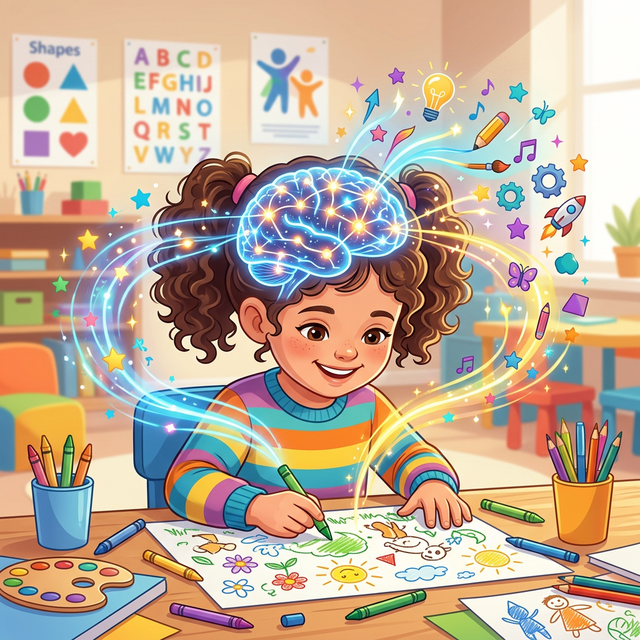
1. Introduction: Neurological Stimulation Beyond Mere Play
Many parents consider coloring activities simply a foundational step in developing artistic intuition or a static method to pass the time. However, according to recent research in child psychology and cognitive early childhood science, the act of filling empty outlines with color has multi-faceted and incredible impacts on a child's brain development. During infancy and early childhood, when neuronal connections are explosively formed, coloring serves as an outstanding training tool that fosters not only cognitive abilities but also emotional regulation and the Executive Function necessary for future learning. In this professional overview, we explore the deep neurological and psychological impacts of coloring on a child's brain.
2. Bilateral Brain Activation and Synaptic Bridging
Our brains are divided into the left hemisphere, responsible for logical and analytical processing, and the right hemisphere, overseeing creative and intuitive processes. Interestingly, coloring is one of the rare activities that simultaneously stimulates and connects both hemispheres.
- Right Hemisphere Activation (Creativity & Spatial Awareness): The process by which a child looks at a given outline and decides which colors to apply and what textures to emulate is deeply intuitive. During this process, the right brain actively operates, heightening aesthetic senses and spatial awareness. The very act of imagining and combining various color harmonies heavily contributes to texture recognition.
- Left Hemisphere Activation (Logic, Rules & Focus): Why does simple coloring stimulate the logical left brain? Coloring operates within the strict boundaries of 'lines.' Carefully controlling hand movements to stay within these boundaries, logically assessing the drawing's structure, and fragmenting the task into smaller parts require a considerable level of analytical thought. This activates the left brain and expands the thickness of the corpus callosum—the bridge between the two hemispheres—thereby accelerating overall neural processing speed.
3. The Prefrontal Cortex and Mechanisms of Emotional & Impulse Regulation
The psychological stability provided by coloring is not merely a placebo effect. American clinical psychologists assert that coloring induces brainwave states akin to meditation. By driving brainwaves into the Alpha wave territory, it actively manages to lower anxiety while elevating tranquility.
Specifically, the Prefrontal Cortex is responsible for 'working memory,' 'concentration,' and 'impulse suppression.' To complete a coloring page, a child must suppress the urge to run away out of boredom and sit still for dozens of minutes. The meticulous act of matching the tip of a colored pencil to small regions calms the amygdala's overactivity and powerfully trains the prefrontal cortex's executive controls. Therefore, coloring is widely adopted as an effective therapeutic intervention for children with high anxiety or ADHD characteristics.
4. The Deep Correlation Between Fine Motor Control and the Language Center
The importance of Fine Motor Skills is well-documented. Practicing the 'tripod grasp'—using the thumb, index, and middle fingers to hold a pencil correctly—lays the essential groundwork for future handwriting. However, experts point to a deeper phenomenon: the meticulous manipulation of hand muscles actively accelerates the development of the brain's language center.
Neuroanatomically, the brain regions overseeing fine finger movements lie exceptionally close to 'Broca's area,' which governs human language formulation and expression. They continuously exchange neural signals. The physical sensory feedback of firmly gripping coloring tools and creating friction across paper feeds directly back to the brain, enhancing synaptic density. Simply put, robust fine motor skills translate into mature cognitive processing and advanced language acquisition.
5. Dopamine Optimization and Self-Efficacy Through Accomplishment
Breathing colorful life into a blank template serves as an excellent visual reward system. When a child completes a single object, and eventually the entire page, the brain secretes Dopamine, a critical reward neurotransmitter. Just like an adult finishing a major corporate project, a child independently navigating a massive task from start to finish is paramount in building 'Self-Efficacy.' Children who constantly experience this cycle of achievement show vastly improved 'Grit'—they are significantly less likely to give up when faced with complex academic problems in the future.
6. Summary and Guidelines for Guardians
Considering the neurological and cognitive evidence presented above, coloring is a perfect, safe simulator for brain training. We strongly recommend parents foster an environment that maximizes these benefits through the following steps:
- Eliminate Perfectionism: Do not intervene if they paint a tree blue or a sky yellow. This is a clear cognitive signal that the right brain is actively running conceptual experiments. Forcing rigid artistic dogmas will only stress the prefrontal cortex.
- Blend with Storytelling: Ask questions like, "Why is that dinosaur wearing a pink coat?" while they color. Integrating language cortical areas with visual cortex areas results in massive multi-dimensional educational value.
- Provide Appropriate Difficulty: Giving extreme mandala patterns to a 4-year-old will halt dopamine flow through frustration. Always provide designs tailored to their precise baseline of fine motor control.
At AI Coloring Book: To Me, our latest generative AI integrations allow parents precisely curate artwork that 100% matches their child's current cognitive level and niche interests. Move beyond arbitrary printing, and take the first professional step toward your child's smart brain boosting journey today.